

Walk into any independent perfume shop in London right now and the conversation has changed. Five years ago, most customers were asking for something clean, fresh, and light. Something that would work in an office without bothering anyone. Something inoffensive.
Those conversations still happen. But they are increasingly being joined by a different kind of request. Customers who want something warmer. Something with real depth. Something that lasts well into the evening and earns a compliment from across a table. Something that smells, as one customer put it, like somewhere interesting.
That somewhere is, more often than not, the Middle East.
What is actually driving this shift
Two things are happening at once, and together they are changing what people in the UK buy and wear.
The first is TikTok. The fragrance community on TikTok, often called PerfumeTok, has given millions of younger buyers their first serious introduction to perfumery as a culture rather than just a product. The creators who attract the largest audiences are not reviewing generic department store launches. They are talking about oud. About layering. About the way a warm amber fragrance behaves differently in the evening than it does in the morning. About what a properly complex oriental fragrance feels like compared to a mass-market fresh scent. This content has an enormous reach, and it has created a generation of fragrance buyers who arrive at the buying decision considerably more educated than their predecessors.
The second driver is travel. Dubai, Abu Dhabi, and other Gulf cities have become major UK travel destinations over the past decade. People who visit the souks of Dubai or walk through the lobbies of its hotels come home changed in a very specific way. The air in those spaces smells extraordinary, and it smells like nothing available in a British supermarket or pharmacy. A significant number of those visitors come home wanting to find that smell again, and they start looking for it in their fragrance purchases.
What the numbers say
The Middle Eastern fragrance market reached 4 billion US dollars in 2025, growing at 7.5% per year. The MENA region is seeing 11% annual growth in fragrance sales. Middle Eastern brands, including Amouage, Arabian Oud, and Kayali, are actively expanding into UK and European retail. The global prestige perfume market grew 12% in 2025 alone, with warm and oriental scent families among the fastest-growing categories.
What makes Middle Eastern perfume different
The differences between Middle Eastern and Western perfumery traditions are real, and they go well beyond the specific ingredients used.
Western perfumery, particularly the French tradition that dominated the luxury market through the twentieth century, has historically favoured precision over intensity. The goal was to create something balanced, elegant, and recognisable in the first few seconds on the skin. A great French perfume announces itself crisply and then develops in a linear and controlled way. The pyramid model, where top notes give way to a heart and then a base, was designed with this intention.
Middle Eastern perfumery has different priorities. Intensity matters more. Longevity matters more. The ambition is not to make something that announces itself politely but to create a scent that develops over hours, reveals different aspects of itself throughout the day, and leaves something behind on the skin after the initial application has long faded. The best Middle Eastern fragrances are described as living fragrances because they continue to shift and deepen as you wear them.
The ingredients that enable this are specific. Oud, which is produced when the Aquilaria tree creates a protective resin in response to infection, is one of the most complex aromatic materials in existence. It has a woody, dark, sometimes leathery quality that sits at the base of a fragrance and continues to project for many hours after application. Amber, saffron, rose oil, and musk are the other building blocks of the Middle Eastern tradition, each contributing warmth, depth, or longevity in a way that lighter Western ingredients typically cannot match.
The specific ingredients to understand
Oud. The material most associated with Middle Eastern perfumery, and for good reason. It has been traded and used in the region for over three thousand years. Real oud, properly sourced, has a quality that no synthetic substitute has yet matched: it smells different on every person who wears it, because it interacts with individual skin chemistry in a way that simpler ingredients do not. It is also extraordinarily long-lasting. A well-made oud fragrance will still be perceptible on the skin six to eight hours after application.
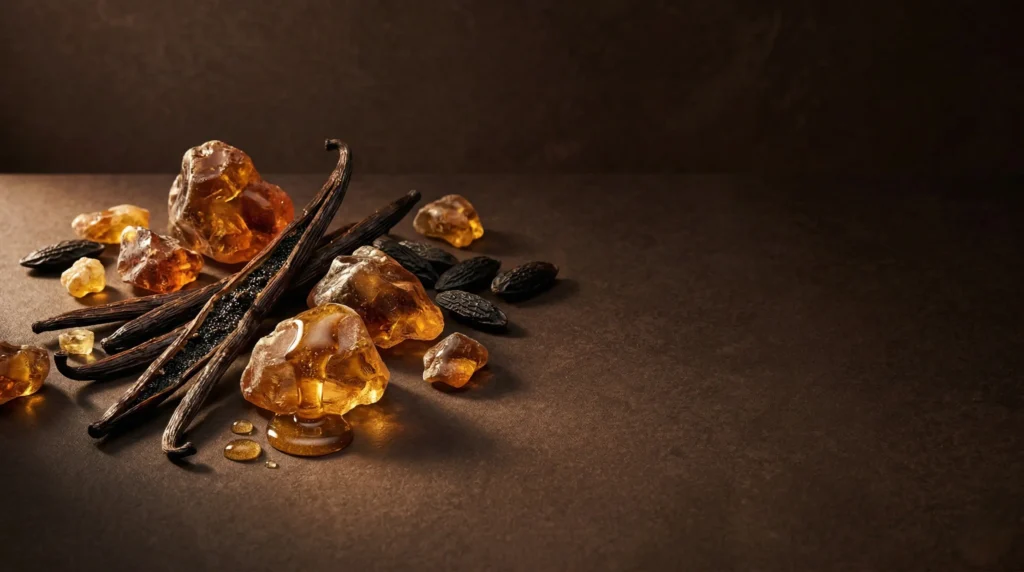
Amber. Not a single ingredient but a blend of resins, typically combining labdanum, benzoin, and vanilla, that creates a warm, sweet, slightly powdery base note. Amber is the ingredient that makes a fragrance feel inviting and intimate. It is also one of the most skin-friendly base notes in perfumery, meaning it blends well with body chemistry and tends to improve as it warms on the skin.
Saffron. One of the most valuable spices in the world and one of the most interesting perfume ingredients. In fragrance, saffron contributes a warm, slightly metallic, honeyed quality that adds complexity without adding sweetness. Levant No. 4, which opens with saffron alongside bergamot and cinnamon, is a clear example of how well this ingredient works in an oriental context.
Rose. The rose grown in the Levant region, particularly the Damascus rose cultivated in the Damask area of Syria, has a quality distinct from the roses used in Western perfumery. It is richer, more honeyed, and slightly more resinous. When combined with warm oriental base notes, as in Levant Nos. 1 and 2, it creates a floral experience that feels very different from the clean, simple rose notes in a typical Western fragrance.
Why UK buyers are responding to it now
There is a broader shift in taste happening across fragrance. After years of the market moving towards cleaner, lighter, and more minimalist scents, buyers are returning to fragrances with texture and presence. Research from fragrance industry analysts consistently shows that warm woods, elegant spice, amber, and oriental accords are among the fastest-growing categories in the UK market right now. Buyers want something that smells expensive and complex, not just pleasant and inoffensive.
This is partly a generational change. The buyers who are driving growth in the UK fragrance market, broadly in the 20 to 35 age group, have grown up in a more globally connected and culturally curious environment than any previous generation. They are more likely to have travelled to the Gulf, to follow Middle Eastern creators on TikTok, and to see Middle Eastern fragrance culture as an aspiration rather than an unfamiliar curiosity. The cultural capital of Dubai and the broader Gulf region has never been higher in the UK, and the fragrance market reflects this.
The world is in love with perfume, and the more intensity, punch, and character a fragrance has, the better.
Rawya Catto, General Manager, CPL Aromas
The five Levant fragrances that sit at the centre of this
The Levant collection was built specifically around this territory. Every fragrance uses oils blended in the Middle East and is built around the ingredient traditions of the region. These are the five to know, mapped to the five scent families in the collection.
| Fragrance | Scent Family | Why it works for this |
|---|---|---|
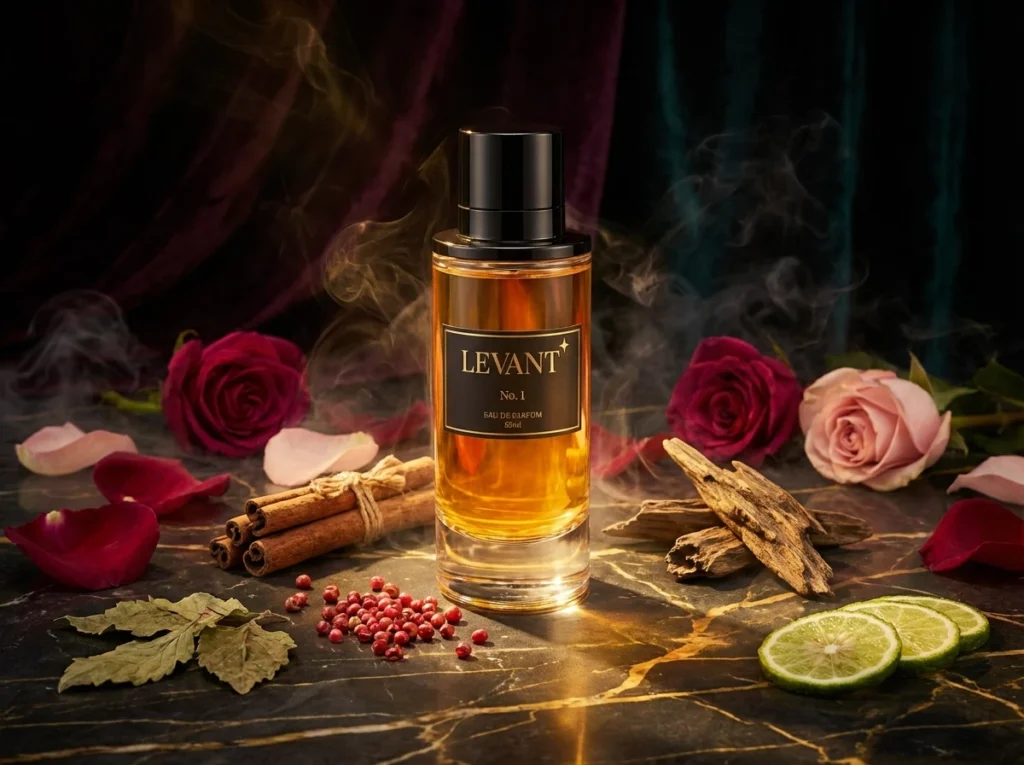
| No. 1 | Floral Oriental | The most accessible entry point. Rose and pink pepper open it; agarwood and vanilla close it. An authentic oriental fragrance that works in a Western daily-wear context without being overwhelming. |
| No. 3 | Wood and Oud | The deepest, most classically Middle Eastern fragrance in the collection. Agarwood, sandalwood, honey, and white amber. This is the fragrance for anyone who wants to understand what oud actually smells like on skin. |
| No. 4 | Spiced Oriental | The most complex. Saffron, cinnamon, tobacco, and leather create a fragrance that rewards patience, revealing different aspects of itself over several hours of wear. |
| Luna Stardust | Spiced Oriental and Tobacco | The boldest fragrance in the range, and the one that has drawn the most attention from those new to the Middle Eastern tradition. Cardamom, black pepper, cumin, and patchouli over cedarwood and vanilla. Strong, distinctive, and long-lasting. |
| No. 2 | Blooming Florals | A softer starting point for those who want to explore the tradition without committing to a full oriental depth. Red rose, jasmine, and lavender over cedarwood and amber. The floral equivalent of the warmer tradition. |
The difference between authentic and approximate
One thing worth understanding is that not all fragrances marketed as oriental or Middle Eastern are the same. The market has seen a significant growth in fragrances that use words like oud and amber on their packaging while containing only synthetic approximations of those materials. A synthetic oud note costs a fraction of the real ingredient and behaves completely differently on the skin: it projects loudly in the first few minutes and then disappears, whereas real oud deepens over time.
The Levant collection uses premium oils that are blended in the Middle East with actual regional ingredients. The difference is audible, if audible is the right word for something you smell: the fragrances develop over the course of the day in a way that simpler compositions do not.
This is not a minor distinction. It is the reason why two fragrances can contain the word amber in their notes list and smell almost nothing alike. Ingredients matter, and where they come from matters. That principle is built into the Levant collection from the ground up.
How to approach it if you are new to this territory
If your current fragrance wardrobe is mostly light, fresh, or floral, moving towards a Middle Eastern scent is easier if you approach it gradually. Start with something that bridges the two traditions rather than jumping straight to the deepest end of the oud spectrum.
Levant No.1 is the right starting point. It has the oriental warmth and depth of the tradition, but it opens with rose and grapefruit that feel familiar to anyone used to Western florals. It is what a perfumer would call a gateway fragrance into the oriental world, complex enough to be interesting, approachable enough not to be overwhelming.
From there, No.2 and No.4 are natural next steps in different directions: No.2 for those who want to explore floral orientals, No.4 for those ready for the full complexity of saffron and spice.
The collection is designed to be explored in this way. Each fragrance is distinct, but they share the same raw material DNA, which means they sit comfortably together as a wardrobe.