


Scroll through fragrance content on TikTok right now and you will find millions of people discovering scent layering as if it were a new invention. Videos showing how to combine two perfumes to create something personal, or how to build a scent from body wash through to a finishing spray, are accumulating hundreds of millions of views. Pinterest named scent stacking as one of its top predicted trends for 2026. Sephora, Space NK, and every major beauty retailer in the UK are writing about it.
None of this is new.
The tradition of layering fragrance has existed in the Middle East for well over a thousand years. Long before people bottled perfume in glass and sold it in department stores, the cultures of the Arabian Peninsula were combining oud, rose water, amber oils, and incense into rituals of scent that were deeply personal, carefully considered, and built to last all day. The rest of the world is currently rediscovering something that has always been second nature in the region that inspired the Levant collection.
What fragrance layering actually is
Layering means applying more than one scented product to the skin so that the resulting smell is something different from any individual component worn alone. It can be as simple as wearing a scented body lotion before your perfume. It can be considered as combining two Eau de Parfums from complementary scent families. The goal is always the same: to create something that feels more personal, lasts longer, and sits more naturally on your skin than a single fragrance applied on its own.
The reason layering works is partly chemistry and partly common sense. Perfume adheres better to moisturised skin. When you apply a scented product that shares notes with your main fragrance, those notes are amplified and extended rather than competing. When you choose two fragrances from opposite ends of a spectrum, one warm and deep and one bright and fresh, the result is often more interesting than either fragrance alone.
The Middle Eastern tradition behind the method
In the Gulf region, fragrance layering begins before you even leave the bathroom. Attar oils, which are concentrated natural fragrance extracts, are applied directly to the skin first. Then comes the main perfume. Then, in many homes, there is the practice of wafting your clothes over an incense burner so that a trace of oud smoke clings to the fabric. By the time a person steps outside, they are carrying three or four distinct aromatic layers, each revealing itself at a different point in the day as the others fade.
This is not excess. It is precision. Each layer serves a purpose: the oil anchors the scent to the skin, the perfume provides the character, and the incense adds a depth that no single bottled fragrance can fully replicate on its own.
Fragrance in the Middle East has always been about building something, not just wearing something. The idea of a single scent doing everything was never the point.
Levant Perfume
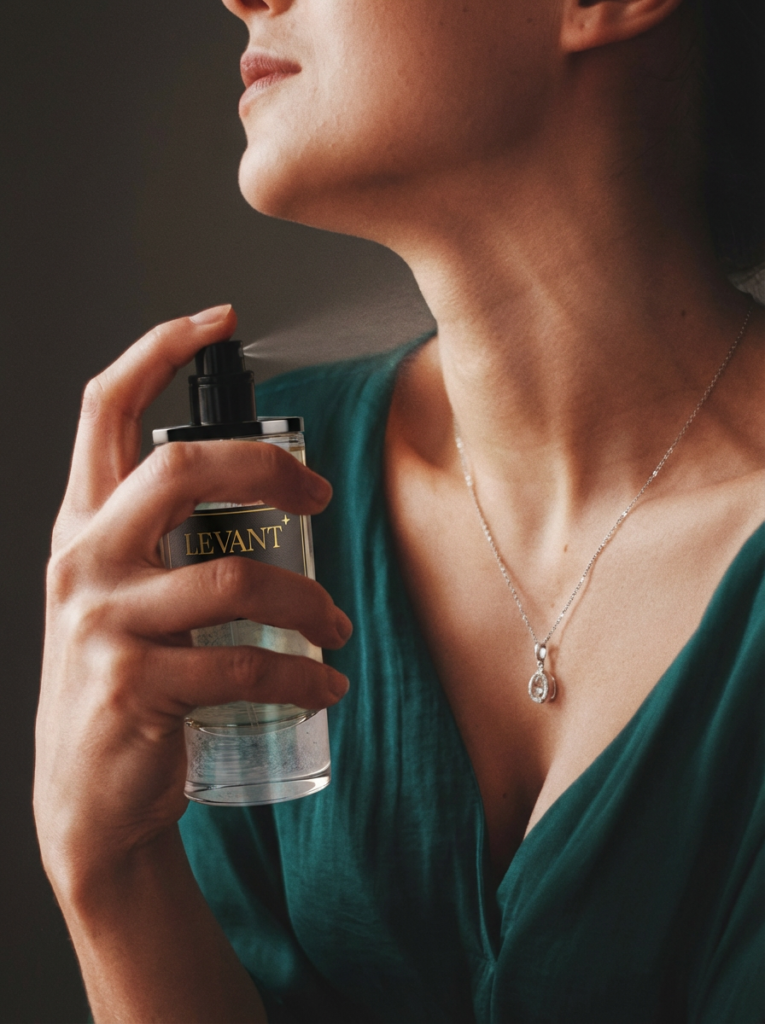
Levant fragrances were created in exactly this tradition. The oils at the heart of each bottle are blended in the Middle East, using ingredients drawn from the same regional heritage: oud, amber, saffron, rose, cedarwood, and warm spice. When you layer them, you are working with materials that were always meant to be combined.
How to start layering properly
You do not need to own ten fragrances to layer well. Most people can create something genuinely compelling with two products and a little understanding of how notes interact.
Step one: moisturise first. Apply an unscented or lightly scented body lotion to clean skin before you apply any fragrance. Dry skin absorbs and releases perfume quickly, which is why some fragrances seem to disappear within an hour. Moisturised skin holds scent significantly longer. If you are using a scented lotion, choose one that either matches your perfume’s scent family or is neutral enough not to clash.
Step two: apply your base fragrance. The base layer should be the richest, warmest, most long-lasting fragrance you own. In the Levant collection, this means the oud and woody end of the range. Levant No. 3, with its deep combination of agarwood, sandalwood, and white amber, works exceptionally well as a base layer. It has longevity and depth without projecting aggressively, which means there is space for a second fragrance to sit on top of it.
Step three: add a second layer on top. Apply your second fragrance to the same pulse points roughly thirty seconds after the first. The second fragrance should contrast with or complement the first. If your base is warm and woody, a lighter floral or citrus layer on top adds brightness without losing the depth underneath. If your base is already quite light and fresh, a warmer second layer gives it staying power.
Step four: let it settle before you judge it. Freshly layered fragrances can smell busy for the first few minutes. Give it ten to fifteen minutes and the top notes will settle into something cohesive. What you smell in the first two minutes is not what you will smell in an hour.
Levant combinations that work well
These pairings have been put together using the actual note structures of the Levant collection. They are starting points rather than rules.
| Base layer | Top layer | What it creates |
|---|---|---|
| No. 3 (oud, sandalwood, honey) | No. 1 (rose, pink pepper, grapefruit) | Warm and floral with real depth. A classic Middle Eastern pairing: the woody base grounds the rosy top note so it reads as elegant rather than sweet. |
| No. 4 (saffron, cedarwood, leather) | No. 5 (orange, bergamot, lemon) | A contrast pairing. The citrus brightness cuts through the rich oriental base and creates something that shifts noticeably over the course of the day. |
| No. 2 (red rose, jasmine, lavender) | Luna Stardust (cardamom, tobacco, patchouli) | Soft florals given a spiced edge. For evenings when you want something feminine but with more presence than the florals alone would give. |
| No. 7 (pineapple, lemon, vanilla) | No. 6 (clementine, blackberry, vanilla orchid) | A fruity layering combination that is bright and radiant without becoming sweet. Best for warm weather and social occasions. |
| No. 3 (agarwood, cedarwood) | Luna Stardust (cardamom, cumin, patchouli) | A full oud and spice combination for those who want a deep, complex evening scent with significant presence. One spray of each is enough. |
Extending the layer into your home
Layering does not have to stop at your skin. One of the oldest Middle Eastern fragrance traditions is the practice of scenting your home and your clothes as extensions of your personal scent. The Levant home collection, which includes room sprays, candles, diffusers, and wax melts, uses the same oil blends as the EDP range. That means you can genuinely carry a cohesive scent from your skin to your living room.
A simple way to extend this: apply your layered perfume in the morning, and in the evening light a candle from the same scent family as your base layer. The result is a home environment that smells continuous rather than jarring. If you have been wearing No. 3 all day, a woody and amber candle in the evening feels like a natural continuation rather than a separate experience.
The mistakes most people make
Using too many sprays. When you layer, you are already applying more than one fragrance. Two sprays of each fragrance will almost always be too much. Start with one spray of the base and one of the top layer, then reassess after the initial dry down.
Choosing two fragrances from exactly the same family. If both layers are heavy orientals or both are light citrus scents, there is nothing for them to do together. Contrast is what makes layering interesting. A warm base with a fresh top, or a floral base with a spiced top, gives the combination a dimension that neither fragrance has alone.
Applying to dry skin without moisturising first. This is the single most common reason a layered scent disappears quickly. The oils in perfume need something to bond to. Moisturised skin is that surface.
Judging it too quickly. Freshly applied fragrance, especially a combination of two, goes through a noisy opening phase. The top notes of both fragrances are competing. Wait for them to settle before deciding whether the combination works.
Why it matters for how you smell
The real reason to learn layering is not to follow a trend. It is because a layered fragrance is genuinely more interesting, more personal, and more lasting than a single spray of anything.
Most perfumes are designed to be complete in themselves. They have a top note, a heart, and a base, and the perfumer has already done the work of making those three elements work together. When you layer two fragrances, you are creating a fourth option that the perfumer did not design, which means it is entirely yours.
In a world where millions of people own the same bottles and wear the same sprays, that is not a small thing.